


Enterprise Gamification ROI: How to Measure Real Business Value for the C-Suite
The challenge for today’s C-Suite is navigating the hype surrounding employee engagement tools. Many executives view gamification as mere entertainment—a sunk cost with no clear return. However, leading corporations are leveraging it as a strategic engine to optimize performance and profitability.
This analysis moves beyond points and badges. We dissect the financial figures, actual costs, and the precise business value of gamification to provide leadership with a data-driven foundation for enterprise investment.
What is Enterprise Gamification ROI?
Enterprise Gamification ROI is the measurable financial return a company earns from integrating game mechanics into core business processes like HR, Sales, and Marketing. It is calculated by comparing the tangible financial benefits gained against the total investment required to build and operate the system.
- Cost Reduction: Lowering employee turnover and recruitment expenses.
- Revenue Generation: Driving higher LTV and accelerating sales cycles.
- Performance Optimization: Increasing productivity and operational efficiency.
How to Calculate Gamification ROI Accurately
To justify the investment, executives need a transparent financial model. The calculation must account for both direct revenue impacts and operational savings over a specified period.
ROI =
Net Profit from Gamification − Cost of Gamification
Cost of Gamification
Cost of Gamification
× 100
- Net Profit: This includes revenue growth from upselling, increased customer lifetime value (LTV), and operational costs saved, such as reduced recruitment spending due to higher employee retention.
- Cost of Gamification: The total capital and operational expenditures required to design, launch, and sustain the program.
The Real-World Application of Net Profit
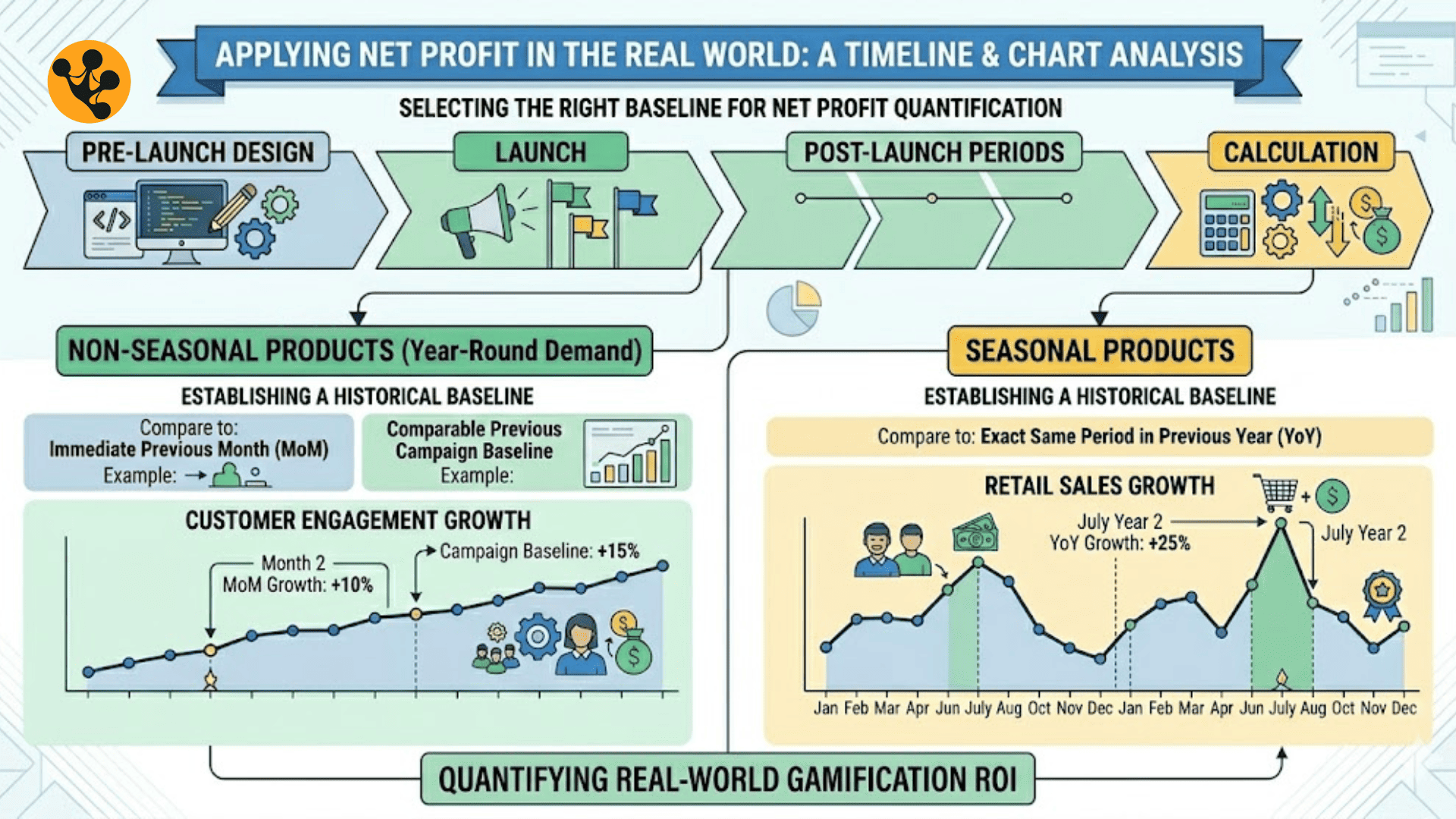
In practice, quantifying this return is rarely as straightforward as a static formula implies. The “Net Profit from Gamification” is typically derived by measuring the percentage growth in key metrics against a strict historical baseline rather than absolute raw numbers.
- For Non-Seasonal Products (Year-Round Demand): Growth is calculated by comparing post-launch performance against the immediate previous month (MoM), previous year, or a comparable preceding campaign baseline.
- For Seasonal Products: To isolate the actual impact of gamification from natural demand fluctuations, performance must be strictly benchmarked against the exact same period in the previous year (YoY).
Breaking Down the Cost of Gamification
A critical step in proving ROI is accurately forecasting the cost of gamification. Unplanned expenses can quickly derail a project’s profitability.
| Cost Category | Detailed Description | Classification |
| Initial Development | UI/UX design, core programming, and legacy system (ERP/CRM) integration. | Fixed Cost (CapEx) |
| Licensing & Platform | Proprietary software licensing, cloud server hosting, and API access fees. | Ongoing Cost (OpEx) |
| Operations & Optimization | Continuous content updates, data analytics, and physical or digital rewards. | Variable Cost |
What Are the Key Gamification Metrics and KPIs?
Measuring the business value of gamification requires looking beyond vanity metrics like daily logins. Strategic tracking aligns specific gamification KPIs with core business objectives across departments.
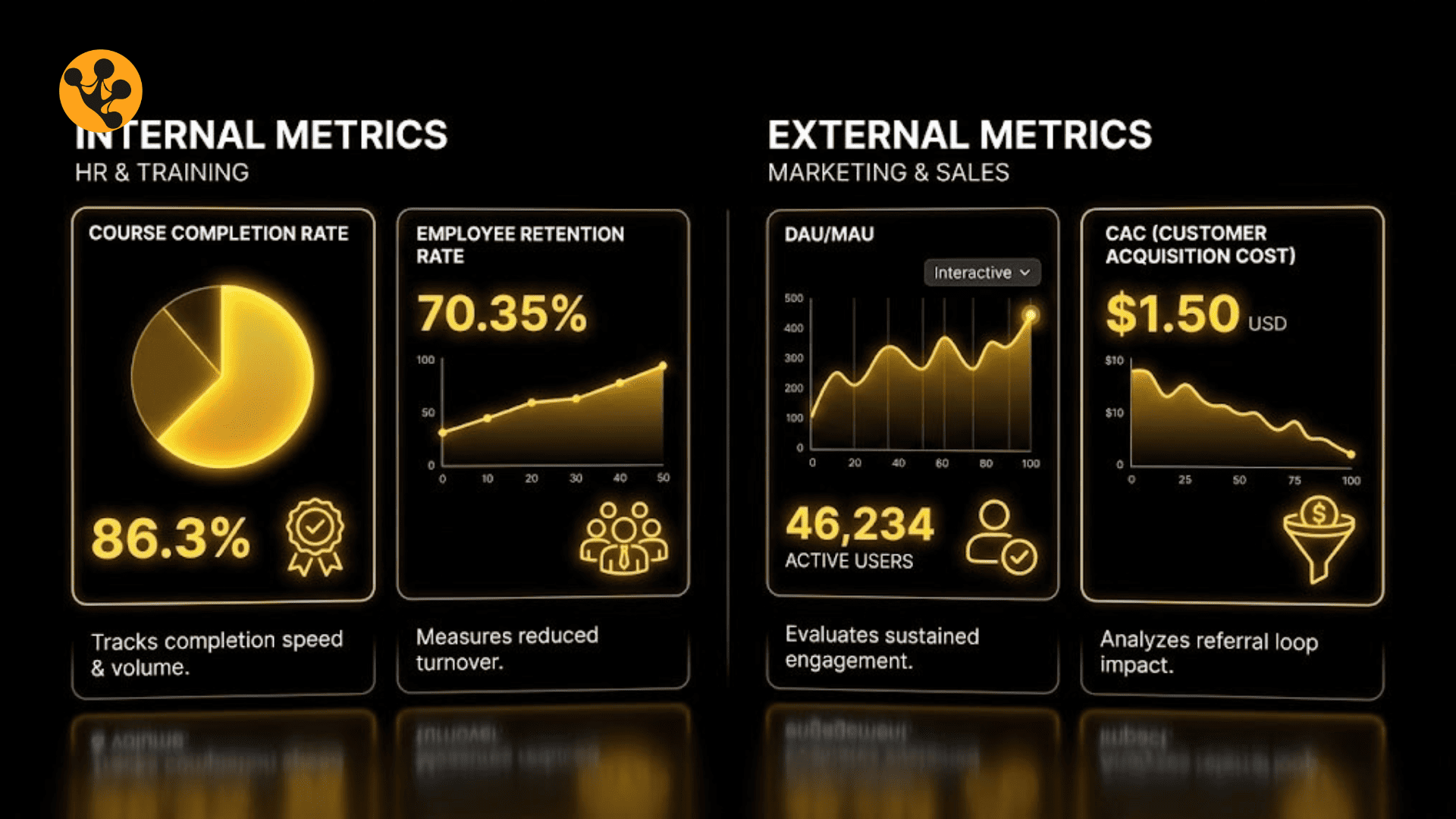
HR & Internal Training (Internal):
- Course Completion Rate: Tracking the speed and volume of compliance or skill training completion.
- Employee Retention Rate: Measuring the direct impact of engagement on reducing costly employee turnover.
Marketing & Sales (External):
- Daily/Monthly Active Users (DAU/MAU): Evaluating sustained engagement with customer-facing applications.
- Customer Acquisition Cost (CAC): Analyzing how gamified referral loops lower the cost of acquiring new users.
3 “Hidden” Factors That Determine the Success of Gamification
Implementing gamification carries specific operational risks. Understanding these hidden factors is crucial for safeguarding the investment and ensuring a positive yield.
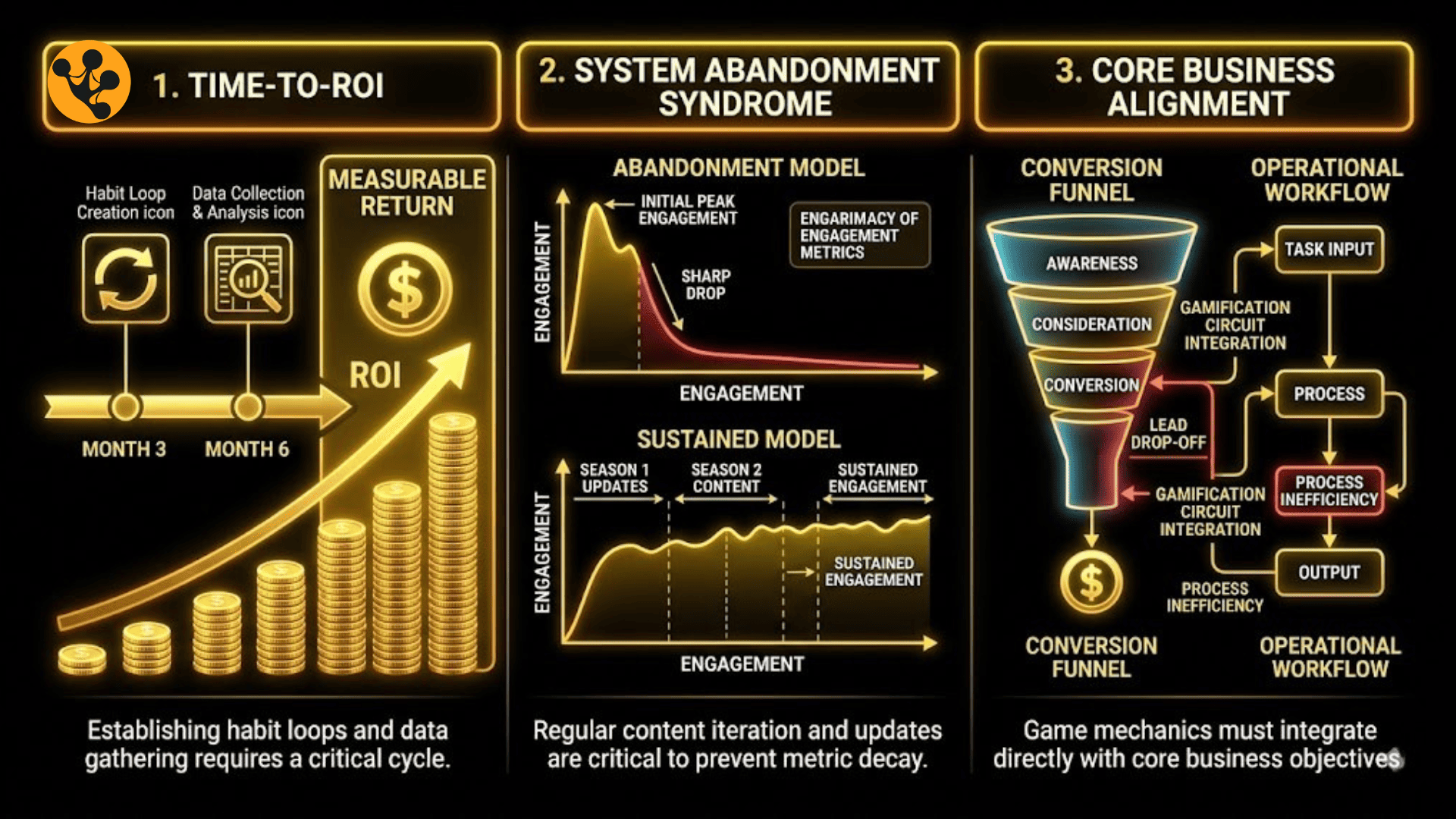
- Time-to-ROI: Gamification is not an instantaneous fix. It typically requires a 3-to-6-month cycle to establish habit loops, gather meaningful data, and start generating a measurable financial return.
- System Abandonment Syndrome: Engagement often spikes initially but drops sharply if the system lacks dynamic updates. Continuous content iteration is required to prevent metric decay.
- Core Business Alignment: If game mechanics do not directly resolve a bottleneck in the conversion funnel or operational workflow, the system becomes a distraction rather than a tool for growth.
Maximizing ROI with Advanced Gamification Solutions
Developing a proprietary gamified system from scratch often leads to inflated CapEx and delayed deployment. For maximum efficiency, companies should leverage specialized expertise.
Partnering with professional development studios to utilize pre-built enterprise apps or Playable Ads significantly optimizes the cost of gamification. This strategic approach ensures rapid deployment, deep data analytics integration, and a clear path to profitability without the overhead of building an internal game studio.


Leave a comment