
How AI Applications Reduce Game Development Time by 50%
In today’s increasingly competitive gaming industry, reducing development time from concept to launch has become a decisive factor for success. Implementing artificial intelligence (AI) in game development not only helps studios save up to 50% of development time but also enhances the quality of the final product.
AI is fundamentally changing how studios approach the game production process, from automating repetitive tasks to optimizing creative workflows. This brings benefits not only in terms of time but also allows developers to focus on more important creative and strategic aspects.
What is AI Application in Game Development?
AI application in game development is the integration of artificial intelligence technologies into the development process to automate, optimize, and enhance the efficiency of tasks ranging from basic to complex. Rather than completely replacing humans, AI acts as an intelligent assistant, helping developers and artists work more effectively.
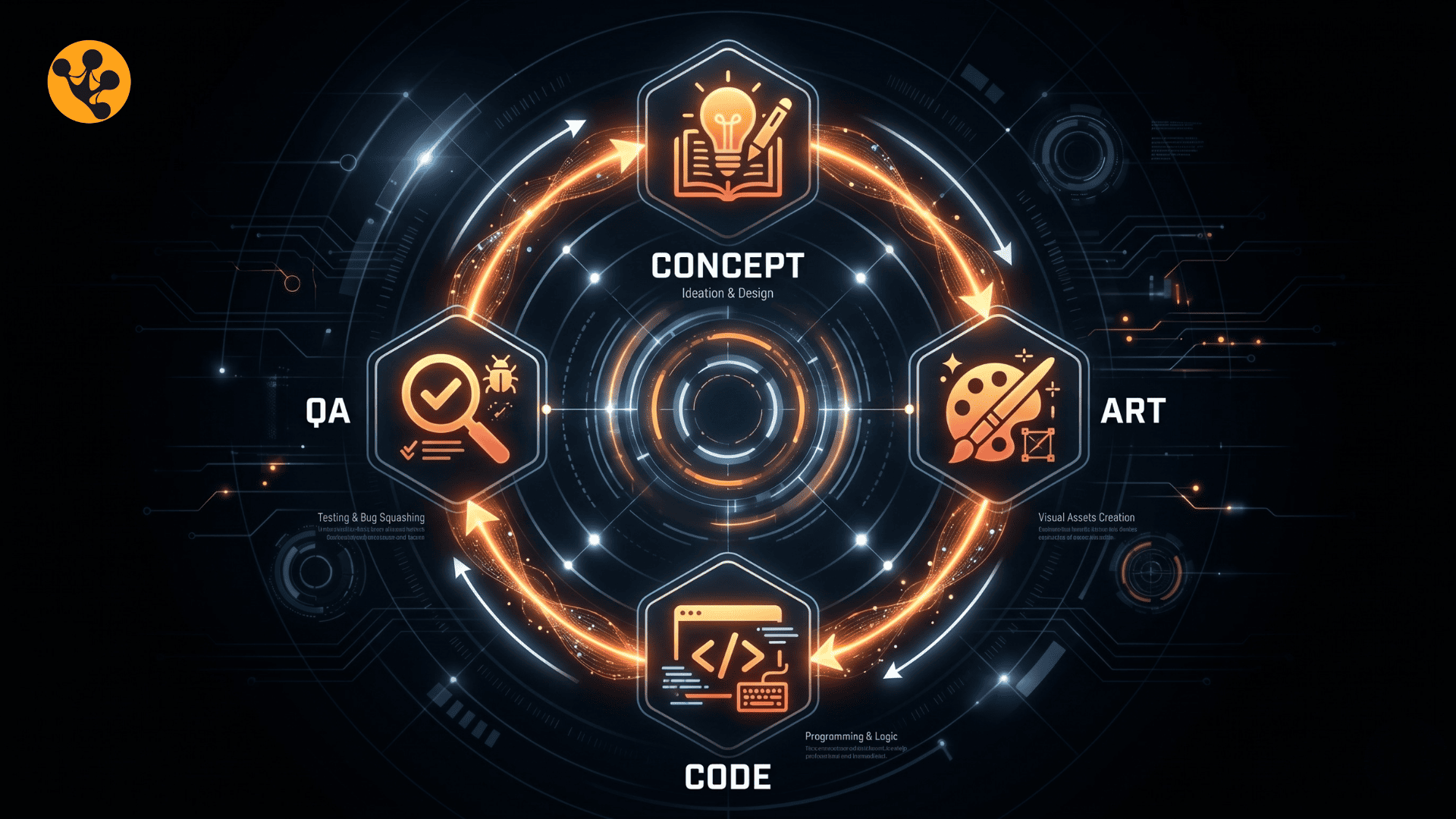
AI can support four main areas of game development:
- Art and Design: Creating concept art, textures, 3D models, and visual assets from text prompts
- Programming: Code generation, auto-completion, debugging, and performance optimization
- Audio: Procedural sound generation, voice synthesis, and dynamic music creation
- Testing: Automated testing, bug detection, and performance analysis
The core benefits of automating the development process include reducing time spent on repetitive tasks, increasing consistency in output quality, and allowing teams to focus on creative aspects and strategic thinking. In today’s competitive landscape, AI is no longer an option but has become a necessity to maintain competitive advantage.
How AI Optimizes Time Through Each Game Development Stage
Traditional game development includes main stages: Pre-production (10-15% of time), Production (60-70% of time), Testing (15-20% of time), and Post-launch support. AI can optimize each stage with different time-saving ratios:
- Pre-production: 40-60% time savings
- Art Production: 50-70% savings
- Programming: 30-50% savings
- Testing: 60-80% savings
Compared to traditional processes, AI-supported workflows enable parallel processing of multiple tasks, continuous iteration with rapid feedback, and automated quality checks. Metrics for measuring effectiveness include time-to-first-playable, asset creation velocity, bug detection rate, and overall project timeline compression.
Concept and Pre-production Stage
In the pre-production stage, AI text generation tools like GPT-4 can automatically create scripts and storylines based on brief descriptions. Instead of spending 2-3 weeks brainstorming and writing game design documents, AI can generate multiple variations in a few hours, allowing teams to focus on refining and polishing the best ideas.
Concept art creation is revolutionized by tools like Midjourney and Stable Diffusion. From a detailed text prompt, artists can generate hundreds of variations of character designs, environment concepts, and UI layouts in one day, compared to taking 1-2 weeks with traditional methods.
The specific workflow includes:
- Using AI to generate initial story outlines and character backgrounds
- Creating mood boards and style references with image generation AI
- Rapid prototyping of core gameplay mechanics with AI-assisted coding
- Automated market research and competitor analysis
Asset Design Stage (Production – Art/Audio)
AI texture generation tools like Substance 3D Sampler can create realistic materials from single reference images, reducing texture creation time from several hours to just minutes. Procedural texture generation allows artists to create infinite variations without manual work.
3D model generation has seen breakthroughs with tools like Meshy and 3DFY, which can convert 2D concepts into 3D models within 15-30 minutes. AI-powered rigging and animation tools help automate character controller setup and basic animations.
For audio production, AI tools like AIVA and Amper Music can create adaptive soundtracks that match gameplay dynamics. Voice AI platforms like Replica Studios allow generation of natural-sounding dialogue for NPCs without voice actors, saving significant budget and time.
Procedural audio generation helps create massive sound effects libraries from minimal input, particularly useful for indie studios with limited budgets.
Programming Stage (Coding)
GitHub Copilot and similar AI coding assistants can increase programming productivity by 40-50%. Auto-completion not only suggests syntax but also understands context and generates entire functions based on comments.
AI debugging tools like DeepCode can identify potential bugs and security vulnerabilities before runtime, significantly reducing debugging time. Smart code refactoring suggestions help maintain clean codebases and improve performance automatically.
Script automation and workflow optimization are enhanced by AI, allowing developers to set up complex build processes, automated testing pipelines, and deployment workflows with minimal manual intervention.
Performance optimization suggestions from AI analysis can identify bottlenecks and recommend specific improvements, particularly valuable for mobile game optimization where performance constraints are critical.
Testing and QA Stage
AI testing bots can simulate realistic player behavior patterns, testing game balance, progression systems, and multiplayer interactions 24/7. This allows identification of issues that human testers might miss due to limited playtime.
Automated bug detection using computer vision can spot visual glitches, UI inconsistencies, and animation problems across different devices and screen resolutions. Machine learning algorithms learn from historical bug data to predict potential problem areas.
Physics and collision testing are automated with AI bots that can execute thousands of test scenarios, ensuring game stability across diverse hardware configurations. Load testing simulation helps predict server performance under various player loads.
AI-powered analytics can process player telemetry data to identify gameplay issues, balance problems, and user experience friction points in real-time.
Step-by-Step Guide to Integrating AI into Project Workflows
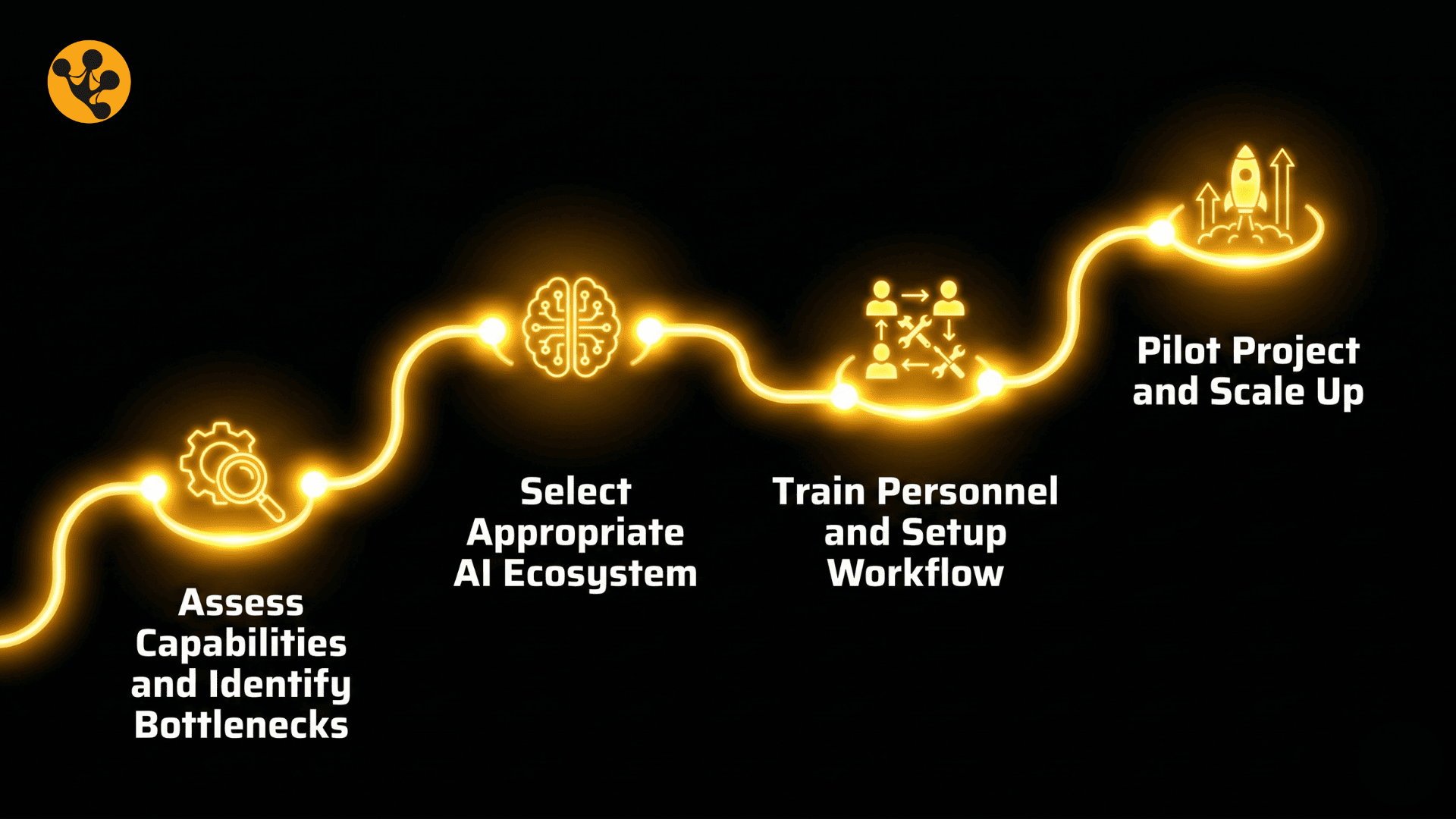
Integrating AI into game development workflows requires a systematic approach to ensure smooth transition and maximize ROI. A 6-month roadmap includes specific milestones and measurable outcomes for each stage.
Implementation timelines should be designed to minimize disruption to ongoing projects while gradually building AI capabilities within the team. Success metrics and KPIs need to be established from the beginning to track progress and justify continued investment.
Step 1: Assess Capabilities and Identify Bottlenecks
The first step requires a comprehensive audit of current workflows and team capabilities. This includes mapping out each process in the development pipeline, from ideation to deployment, and identifying pain points where AI can deliver the greatest impact.
Skill assessment should cover technical competencies, creative capabilities, and adaptability to new tools. Survey team members about current challenges and areas where they spend most time on repetitive tasks.
Bottleneck identification through data analysis of project timelines, resource allocation, and quality metrics. Common bottlenecks include asset creation backlogs, code review delays, testing cycles, and iteration feedback loops.
Establish baseline measurements for key performance indicators such as:
- Average time per asset creation
- Code completion rates
- Bug detection and fix turnaround time
- Overall project milestone completion rates
Step 2: Select Appropriate AI Ecosystem
Tool selection depends on studio size, budget constraints, and specific needs identified in the assessment phase. Indie studios (1-10 people) should focus on cost-effective cloud-based solutions, while larger studios can invest in enterprise-grade tools with advanced customization.
Compare investment costs versus projected time savings to calculate expected ROI timeline. Consider not just subscription costs but also training time, integration effort, and potential productivity loss during the transition period.
Compatibility assessment with existing tools and pipelines is crucial to avoid workflow disruption. Many modern game engines have built-in AI integrations or officially supported plugins.
Scalability considerations include ability to handle increased team size, project complexity growth, and future technology adoption. Choose platforms with strong developer communities and regular updates.
Step 3: Train Personnel and Setup Workflow
Prompt engineering training is essential for maximizing AI tool effectiveness. Team members need to learn how to craft specific, detailed prompts that generate desired outputs consistently. This includes understanding AI limitations and learning to iterate prompts for better results.
Workflow integration requires redesigning existing processes to accommodate AI tools while maintaining quality standards. Create new collaboration protocols between human creativity and AI assistance.
Quality control processes need to be established to ensure AI-generated content meets project standards. This includes human review checkpoints, automated quality metrics, and feedback loops for continuous improvement.
Documentation of new processes, best practices, and troubleshooting guides is essential to ensure consistency and knowledge transfer within the team.
Step 4: Pilot Project and Scale Up
Select a module or feature with manageable scope to test AI integration without risking the entire project. Ideal pilot projects have clear success criteria and limited dependencies on other systems.
Measurement and evaluation phases should capture both quantitative metrics (time saved, quality scores, error rates) and qualitative feedback (team satisfaction, creative satisfaction, workflow smoothness).
Iterative improvement based on pilot results, addressing pain points and optimizing processes before full deployment. Document lessons learned and create playbooks for future implementations.
Full-scale deployment strategy should include phased rollout, ongoing training programs, performance monitoring, and continuous optimization based on real-world usage data.
Comparison Chart of Effective AI Tools in Game Development
Choosing the right AI tools can make or break your implementation success. This comprehensive comparison covers 15+ leading tools across categories, evaluated based on 8 critical criteria: output quality, ease of use, integration capability, cost effectiveness, learning curve, support quality, scalability, and innovation trajectory.
Specific recommendations depend on use case scenarios, team size, and technical sophistication level. Pricing model analysis includes subscription tiers, usage-based billing, and enterprise licensing options with realistic ROI projections.
AI Tools for 2D/3D Art Design
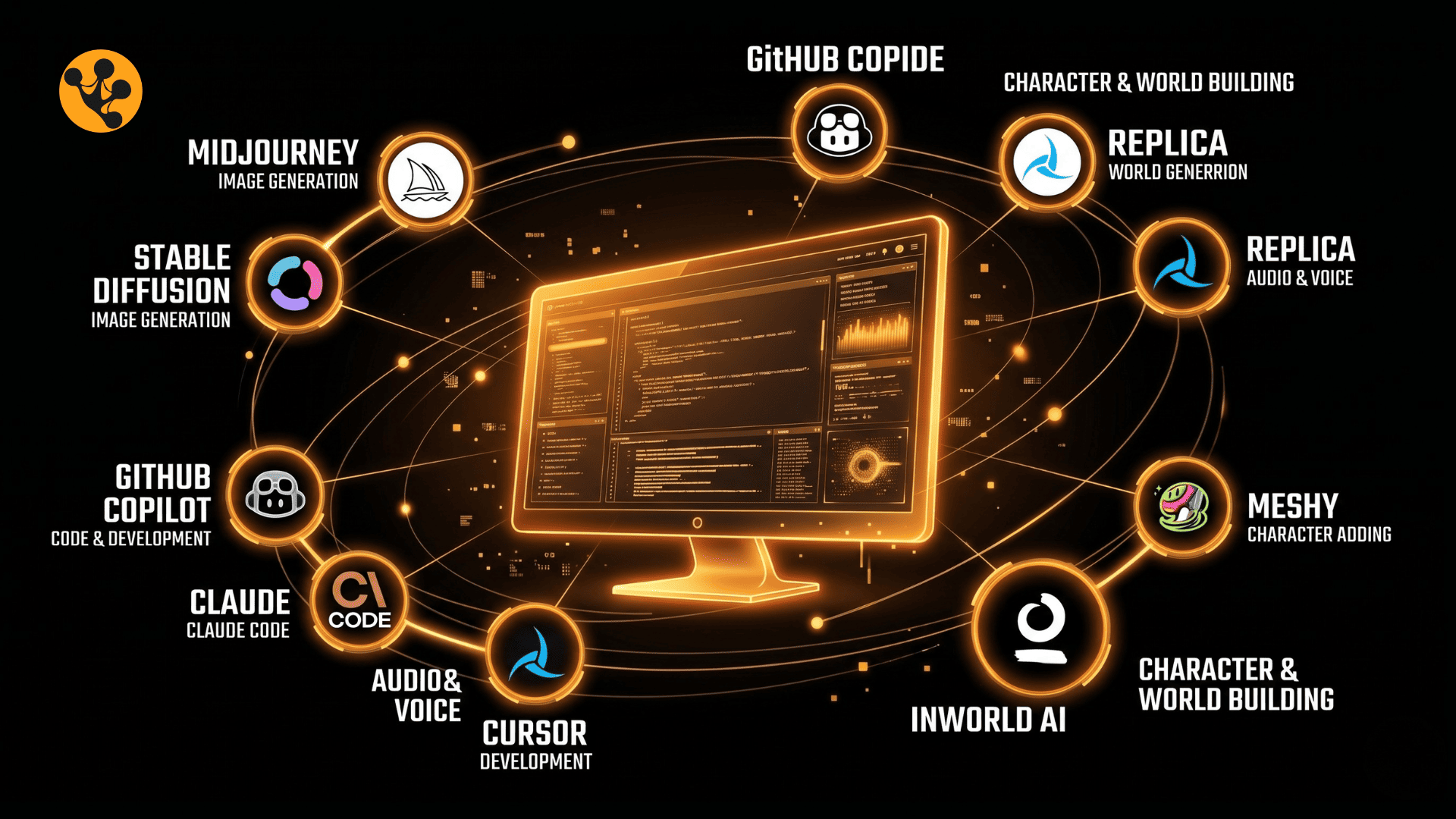
Midjourney excels at concept art generation with exceptional artistic quality and style consistency. Subscription starts at $10/month, offering excellent value for indie developers. Learning curve is moderate, with strong community support and extensive tutorials.
Stable Diffusion provides more technical control with open-source flexibility. Free to use with self-hosting options, making it cost-effective for studios with technical expertise. Training and customization capabilities are superior for specific art styles.
Meshy specializes in 3D model generation from 2D references or text descriptions. Processing time is 15-30 minutes per model, a significant improvement over traditional 3D modeling workflows. Subscription tiers range from $20-200/month depending on usage volume.
Cost-per-asset analysis shows 60-80% savings compared to traditional art production, with quality sufficient for most indie and mid-tier projects. Enterprise applications may require additional human refinement.
AI Coding and Development Tools
GitHub Copilot leads in code generation accuracy with contextual understanding across multiple programming languages. $10/month per user, with enterprise tiers available. Integration is seamless with popular IDEs, with minimal learning curve.
Cursor offers an innovative AI-powered code editor experience with superior context awareness. Free tier available, pro features at $20/month. Particularly strong for Python and JavaScript development.
Programming language support varies across tools, with most covering popular game development languages like C#, C++, JavaScript, and Python. Framework compatibility includes Unity, Unreal Engine, and popular web frameworks.
Productivity gains typically range from 30-50% for routine coding tasks, with higher impact on boilerplate code, testing, and documentation generation.
AI for Audio and NPC Behavior
Replica Studios provides high-quality voice synthesis with natural-sounding character voices. Pricing starts at $4/month for basic usage, scaling to enterprise solutions for large projects. Voice quality is suitable for most commercial applications.
AIVA specializes in procedural music generation with style customization options. Subscription tiers range from free to $33/month for commercial usage. Output quality is professional-grade for background music and ambient soundtracks.
Inworld AI creates sophisticated NPC behavior systems with natural conversation capabilities. Enterprise-focused pricing, typically requiring custom quotes. Implementation complexity is higher but offers significant gameplay enhancement potential.
Technical requirements vary significantly, with cloud-based solutions offering easier implementation but potentially higher ongoing costs compared to self-hosted alternatives.
Investment Cost Analysis and ROI Calculation When Using AI
Financial analysis of AI implementation must consider both direct costs (software subscriptions, hardware upgrades, training) and indirect benefits (faster time-to-market, improved quality, competitive advantage). Accurate ROI calculation requires careful measurement of current baseline performance and projected improvements.
Break-even calculations typically show positive returns within 6-18 months for most studio sizes, with larger operations seeing faster payback due to scale benefits. Risk assessment should include technology obsolescence, dependency risks, and potential over-reliance on AI tools.
Investment Costs for 3 Studio Scales
Indie Studio (1-10 people): Initial investment $1K-10K covering essential AI subscriptions, basic training, and minor hardware upgrades. Recommended tools include Midjourney, GitHub Copilot, and basic AI audio tools. Monthly recurring costs $100-500.
Mid-size Studio (10-50 people): Investment range $10K-50K including enterprise subscriptions, comprehensive training programs, workflow integration consulting, and specialized hardware. Expected monthly costs $1K-5K depending on usage intensity.
Large Studio/Enterprise (50+ people): Implementation costs $50K+ covering custom integrations, dedicated AI infrastructure, extensive training programs, and specialized consulting. Monthly operational costs can exceed $10K but provide proportional productivity gains.
Scalable pricing models offer flexibility to start small and expand as benefits become apparent. Many providers offer educational discounts and startup programs to reduce initial barriers.
ROI Calculator and Break-even Analysis
Time-to-market improvement typically ranges from 20-50% depending on implementation scope. For a typical mobile game with a 12-month development cycle, AI integration can reduce the timeline to 6-9 months, enabling earlier revenue generation and competitive advantages.
Cost reduction calculations must factor labor savings against AI subscription costs. Example: If AI reduces art production time by 60%, a $5K/month AI budget could replace $15K/month in outsourcing costs, netting $10K monthly savings.
Quality improvement impact often leads to better user reviews, higher retention rates, and increased monetization potential. Quantifying this requires analysis of similar projects with and without AI assistance.
Long-term financial benefits include reduced dependency on expensive outsourcing, ability to handle larger projects with the same team size, and faster iteration cycles enabling better market responsiveness.
Can You Create Games with AI Without Programming Skills?
The short answer is: yes, but with significant limitations regarding complexity and quality of the final product. Low-code/no-code platforms like GameMaker Studio, Construct 3, and Unity’s Visual Scripting have integrated AI capabilities, allowing non-programmers to create functional games.
Realistic capabilities of using AI tools without coding knowledge include:
- Creating simple puzzle games, platformers, and basic mobile games
- Generating art assets, sound effects, and basic animations
- Creating game narratives and dialogue systems
- Setting up basic monetization and analytics

However, current limitations include inability to create complex gameplay mechanics, advanced AI behaviors, multiplayer systems, or sophisticated technical optimizations. AI tools excel at generating content but still require human guidance for game design decisions and player experience optimization.
Minimum skills needed for success include game design fundamentals, basic understanding of target platform constraints, user experience principles, and ability to iterate based on feedback. Technical skills can be supplemented by AI, but creative vision and strategic thinking remain human responsibilities.
Realistic expectations for beginners: AI significantly lowers the barrier to entry, but creating successful, polished games still requires dedication, learning, and multiple iterations. Begin with simple projects to build experience before attempting complex productions.
Can AI Replace Humans in Game Development?
AI in game development is best understood as an intelligent co-pilot rather than a replacement for human creativity and expertise. Current AI capabilities excel at task automation, pattern recognition, and content generation, but lack the contextual understanding, emotional intelligence, and creative problem-solving that drive compelling game experiences.
Irreplaceable value of human creativity includes:
- Understanding player psychology and emotional engagement
- Making complex design decisions that balance fun and challenge
- Creating narrative experiences that resonate with audiences
- Solving novel technical problems that require innovative thinking
Human intuition about what makes games enjoyable, ability to empathize with target audiences, and capacity for creative risk-taking remain uniquely human traits. AI can suggest and generate, but humans must curate, direct, and make final creative decisions.
The most effective model is human-AI collaboration where AI handles repetitive, time-consuming tasks while humans focus on high-level creative direction, player experience design, and strategic decision-making. This partnership amplifies human capabilities rather than replacing them.
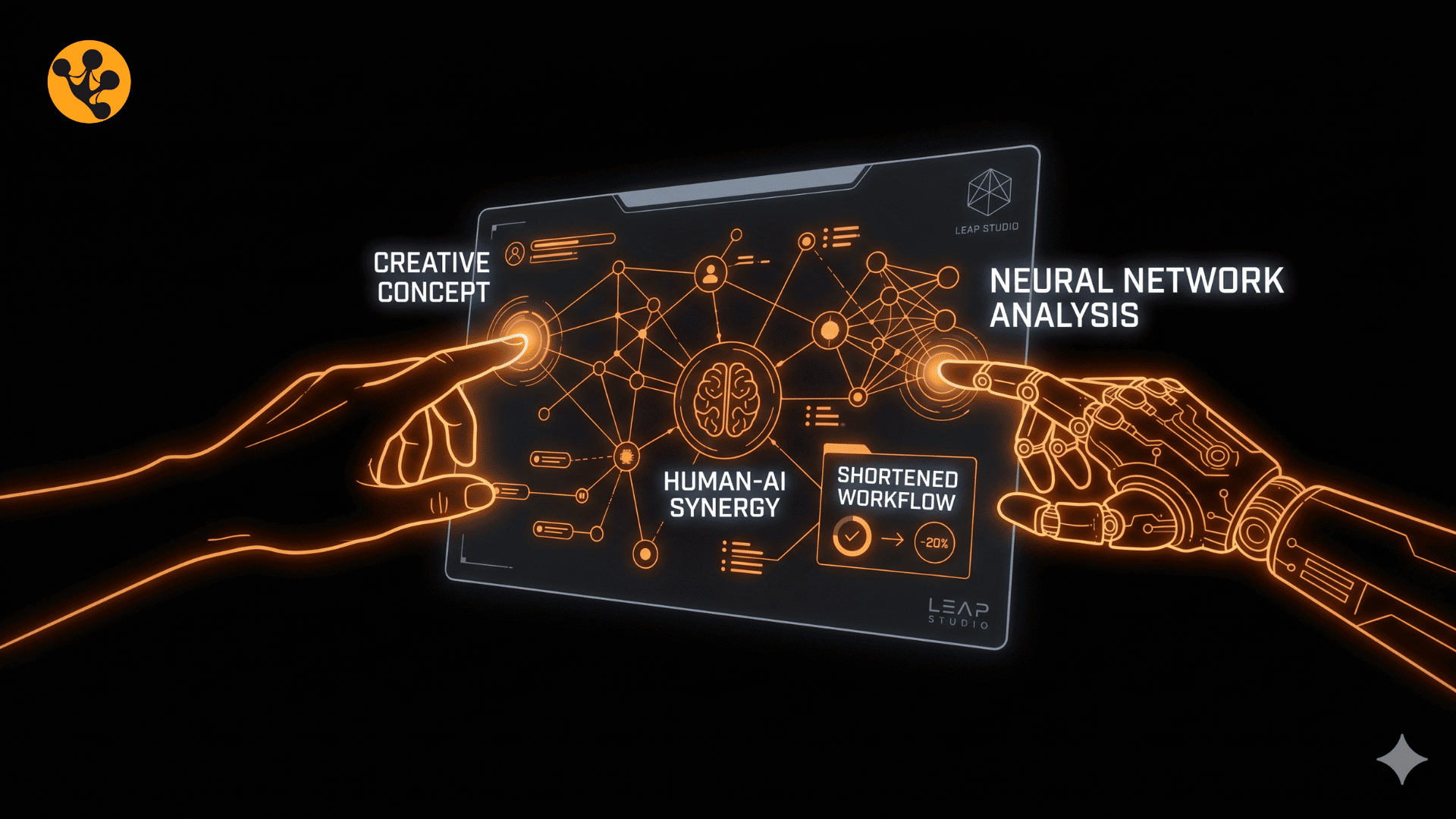
Future trends suggest increasing sophistication in AI tools, but also growing importance of human skills in creativity, emotional intelligence, and strategic thinking. Professionals who learn to effectively collaborate with AI tools will have significant competitive advantages over those who resist adoption.
Successful game development teams of the future will combine AI efficiency with human creativity, using technology to enhance rather than replace human talent. This requires ongoing learning, adaptability, and willingness to evolve working methods as AI capabilities continue advancing.
Conclusion
Implementing AI in game development is no longer a luxury but has become a necessity to maintain competitive advantage in an increasingly crowded market. Studios that adopt AI strategically can achieve significant time savings, cost reductions, and quality improvements while maintaining creative control and human touch.
The key takeaway is that AI serves best as a powerful assistant that amplifies human capabilities rather than replacing creative vision. The balance between leveraging AI efficiency and preserving human creativity is crucial for long-term success.
We encourage studios to start with small pilot projects to experience the direct benefits of AI integration. Start with tools that address your biggest pain points, measure results carefully, and gradually expand implementation as confidence and expertise grow.

“I’m Paul Nguyen, I’m a Growth & Product Marketing Leader and currently the General Manager at LEAP Studio. With over six years of experience across fintech platforms, tech startups, and Web3, I specialize in building data-driven growth strategies, optimizing conversion funnels, and integrating AI into marketing to drive sustainable business scalability.”


Leave a comment